



The Sam and Ann Barshop Institute for Longevity and Aging Studies at UT Health San Antonio, the academic health center of The University of Texas at San Antonio (UT San Antonio) will receive up to $38 million to lead a national clinical trial funded by the Advanced Research Projects Agency for Health (ARPA-H), an agency of the U.S. Department of Health and Human Services.
The five-year contract will support the Validation and Intervention Testing for Aging, Longevity and Healthspan (VITAL-H) trial, part of the agency’s Proactive Solutions for Prolonging Resilience program (PROSPR).
Participant enrollment for the clinical trial will start next year. The university will be joined by other research teams across the United States, called “performer teams.”
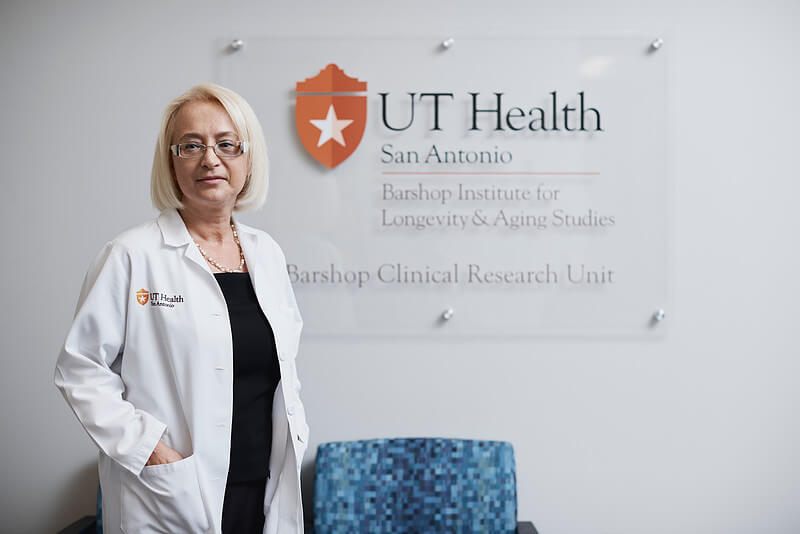
“This places us among the leaders of testing innovative interventions for healthy longevity,” said Elena Volpi, MD, PhD, FGSA, director of the Barshop Institute, professor of geriatrics, gerontology and palliative medicine in the Joe R. and Teresa Lozano Long School of Medicine and principal investigator of the VITAL-H trial.
Longevity research through the years
For decades, the longevity research field has depended on studies using animal models. At UT Health San Antonio, that work began more than 50 years ago focused on the biological mechanisms of aging using cellular systems, lower organisms such as roundworms and fruit flies, and rodents.
“We were selected in part because of our historical successes in aging research and discovery,” Volpi said.
About 20 years ago, the university became one of three national sites in the Interventions Testing Program, evaluating compounds in mouse models to determine whether they extend lifespan.
“We now have drugs approved by the FDA [U.S. Food and Drug Administration] for other uses,” Volpi said. “The question is whether we can translate that into humans in a rigorous, regulated way.”
Testing healthspan effects of three promising drugs
The VITAL-H trial will enroll 726 adults in their 60s and compare three FDA-approved medications — rapamycin, dapagliflozin and semaglutide — against placebo across four study arms.
“The concept in geroscience is that aging modifies a relatively small number of core biological mechanisms that drive most diseases. If we target those mechanisms, one intervention could influence many outcomes,” Volpi said.
Semaglutide, a glucagon-like peptide 1 (GLP-1) receptor agonist, was developed to control glucose in diabetes and promote weight loss, and post-market data show it also reduces cardiovascular events. Dapagliflozin is a diabetes drug that improves metabolic health and lowers cardiovascular risk. Rapamycin was developed as an immunosuppressant at higher doses, but at low doses, it has shown beneficial effects on inflammation and other aging biomarkers.

Redefining a measure of health
One of the most important goals of the trial will be the validation of intrinsic capacity, a composite measure of physical and mental functionality, as an outcome of health. Study participants will undergo testing across five domains of functionality. The Stanford University performer team will carry out the intrinsic capacity validation, drawing in part on data contributed by UT San Antonio.
“We want the FDA to recognize intrinsic capacity as a meaningful, regulatory-grade endpoint,” Volpi said.
Decentralized model for data collection
The VITAL-H trial will use a hybrid, decentralized design for completing participant assessments. This trial will be the first time UT San Antonio has used the model.
Study participants will take one pill daily, wear a health-tracking ring that monitors physical activity, heart health and sleep and complete in-person assessments at any one of multiple sites across San Antonio.
“This gives us the opportunity to meet participants where they are, making participation easier and more accessible,” Volpi said.
Future of healthy longevity
For UT San Antonio, the ARPA-H contract is both recognition of decades of aging research conducted at the institution and a responsibility to continue that research.
“We asked for the bicycle and now we have to pedal,” Volpi said.
Participation in trials at the Barshop Institute
Recruitment has not yet begun for this trial, but individuals interested in this or other studies can learn more or join the interest list at Become a Study Participant – Barshop Institute or by calling the Barshop clinic at 210-350-3333.